


SEO is still one of the best investments a small business can make. You do not need a big agency or a large budget. You need a clear plan and consistent effort.
This guide covers exactly how to do SEO for small business in 2026. Whether you are starting from scratch or trying to fix a site that has stopped growing, every section below is actionable.
What Is SEO and Why Does It Matter for Small Businesses?
SEO stands for Search Engine Optimization. It is the process of making your website visible when people search for what you offer on Google and other search engines.
Organic search drives roughly 53% of all website traffic. Paid ads account for only 15%. That gap is why SEO matters so much for small businesses with limited marketing budgets.
The results compound over time. A well-optimized page can drive free traffic for years. One good piece of content will outlast any ad campaign you run.
The SEO landscape in 2026 has shifted. Google AI Overviews now appear in about 26% of US searches. Answer engines like ChatGPT and Perplexity respond directly without sending users to any website. Despite this, local and transactional searches remain largely unaffected. These are exactly the queries where small businesses win customers.
A small business with real expertise and genuine customer relationships can outrank large brands on the right keywords. That is one of the few places where size works against the competition, not in their favor.
Step 1: Do Keyword Research the Right Way
Keyword research is the foundation of everything. Get it wrong and you spend months creating content nobody searches for.
Start with what your customers actually type.
Think about the problems your customers are trying to solve. Then use free tools like Google Keyword Planner or the free tier of Ubersuggest to find real search terms. Google’s autocomplete and the “People also ask” section are also underrated research tools.
Target long-tail keywords first.
Long-tail keywords are specific phrases with three or more words. They have lower search volume but much higher conversion rates. “Plumber in Austin for burst pipe” converts better than just “plumber.” For a new site, these are your fastest path to rankings.
Understand search intent.
Every keyword has an intent behind it. Informational intent means the user wants to learn something. Commercial intent means they are comparing options. Transactional intent means they are ready to buy.
Match your content to the right intent. If someone searches “best accounting software for freelancers,” they want a comparison article, not a product page. Google penalizes mismatched content.
Build keyword clusters.
Group related keywords together. Each cluster becomes a content topic. For example, a bakery might have clusters around custom cakes, wedding cakes, and cake delivery. This approach helps you build topical authority faster than publishing random articles.
If you want a deeper breakdown of keyword strategy, read our guide on keyword research for beginners.
Step 2: Fix Your Technical SEO Foundation
Technical SEO is about making sure Google can find, crawl, and understand your website. Without it, even great content will not rank.
Check that your site is indexed.
Open Google and type site:yourdomain.com. If your pages appear, Google has found you. If nothing shows up, your site may be blocking search engines. Check your robots.txt file and make sure the “noindex” tag is not accidentally applied to important pages.
Make your site mobile-first.
Google uses mobile-first indexing. That means it primarily reads your site the way a phone user sees it. Your mobile site needs the same content, the same headings, and the same internal links as your desktop version.
Improve your Core Web Vitals.
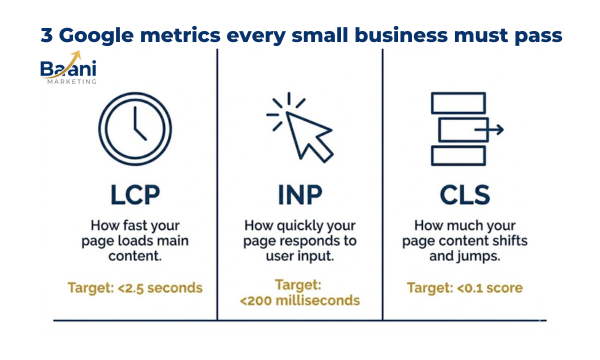
Core Web Vitals are Google’s metrics for measuring real user experience. There are three you need to care about:
- LCP (Largest Contentful Paint): how fast the main content loads. Aim for under 2.5 seconds.
- INP (Interaction to Next Paint): how quickly your page reacts to clicks and taps.
- CLS (Cumulative Layout Shift): how stable the page looks as it loads.
Use Google Search Console and PageSpeed Insights to check your scores. Pages loading under 2 seconds have a 9% bounce rate. Pages taking over 5 seconds have a 38% bounce rate. That difference alone can determine whether a visitor becomes a customer.
Use HTTPS.
If your site still runs on HTTP, that is a ranking problem and a trust problem. Your hosting provider can add a free SSL certificate through Let’s Encrypt in minutes.
Add schema markup.
Schema is code that tells Google exactly what your page is about. For a small business, the most important types are LocalBusiness schema, FAQ schema, and Product schema. You do not need to write code manually. Tools like Rank Math and Yoast SEO can add schema through simple settings.
Step 3: Optimize Every Page with On-Page SEO
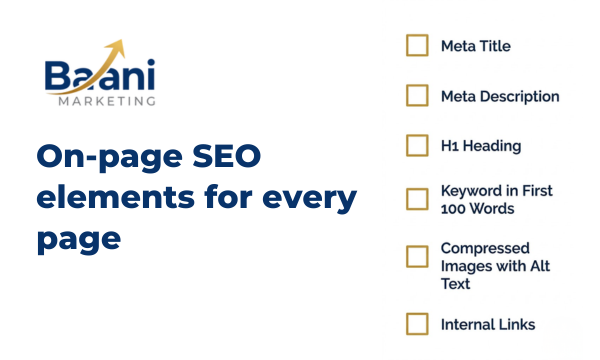
On-page SEO means optimizing each piece of content so Google understands what it is about and who it is for.
Write a strong meta title.
The meta title is the clickable blue headline in Google search results. Keep it under 60 characters. Put your focus keyword near the front. Make it specific and worth clicking.
Bad example: “Home | BaaniMarketing” Good example: “Digital Marketing Services for Small Businesses | BaaniMarketing”
Write a compelling meta description.
The meta description appears below the title in search results. It does not directly affect rankings, but it affects click-through rate. Keep it under 160 characters. State what the page offers and add a reason to click.
Use headings correctly.
Your page should have one H1 tag with the focus keyword. Use H2 and H3 headings to break up the content logically. Headings help both Google and readers navigate your page.
Put your keyword in the first 100 words.
Google gives more weight to what appears early on a page. Introduce your focus keyword naturally in the opening paragraph without forcing it.
Optimize images.
Compress every image before uploading. Use descriptive file names instead of “IMG_4829.jpg.” Write alt text that describes the image accurately. This helps with both page speed and image search rankings.
Internal linking matters more than most people think.
Every new post should link to related pages on your site. Internal links pass authority around your website and help visitors find relevant content. We cover this in detail in our article on building an internal linking strategy.
Step 4: Set Up and Optimize Your Google Business Profile
For most small businesses, local SEO will generate more revenue than any other SEO activity. Your Google Business Profile (GBP) is the single most important local SEO asset you have.
Claim your profile.
Go to Google Business Profile and claim or create your listing. Make sure the business name, address, phone number, and hours are 100% accurate. Inconsistency in your business details across the web confuses Google and hurts local rankings.
Fill out every section.
Most business owners fill in the basics and stop. Do not stop. Add your service areas, list your individual services or products, upload real photos of your business, and write a keyword-rich business description.
Get Google reviews consistently.
Reviews are one of the strongest local ranking signals. Ask happy customers to leave a review right after a positive experience. Respond to every review, including negative ones. A business with 40 reviews will almost always outrank one with four, even with identical optimization.
Post updates regularly.
Google lets you publish posts directly to your Business Profile. Short updates about offers, new services, or useful tips tell Google your profile is active. Active profiles tend to rank higher in local map results.
Step 5: Create Content That Actually Ranks
Publishing content is how you target informational keywords and build authority over time. But content for the sake of content does not work in 2026.
Write for humans first, then optimize for Google.
Google has gotten very good at recognizing thin, generic, or AI-padded content. Write content that genuinely helps your specific audience. Specific answers outperform general overviews every time.
Cover one topic per post.
Each blog post should target one primary keyword and cover the topic thoroughly. Do not try to rank for ten things with one article. Depth on one subject beats shallow coverage of many.
Show E-E-A-T signals.
E-E-A-T stands for Experience, Expertise, Authoritativeness, and Trustworthiness. These are signals Google looks for when evaluating content quality. Show who wrote the article, include real examples from your experience, cite credible sources, and add an author bio.
Update content regularly.
A guide published in 2023 with outdated information will lose rankings over time. Set a reminder to review and update your key pages every six to twelve months. Refreshing old content is often faster than creating something new and can recover lost rankings quickly.
Answer questions your customers are already asking.
The “People also ask” boxes in Google search are a free list of questions your potential customers type every day. Build content around those questions and you will start capturing featured snippets and AI Overview citations.
Step 6: Build Backlinks Without Getting Penalized
Backlinks are links from other websites pointing to yours. They are still one of Google’s strongest ranking signals in 2026.
Focus on quality over quantity.
One link from a respected industry publication is worth more than one hundred links from unknown blogs. A single backlink from a local newspaper or a relevant trade association can move your rankings noticeably.
Earn links with useful content.
Original research, detailed guides, free tools, and local data attract natural links. If you publish something genuinely useful, other sites will reference it without you asking.
Use digital PR.
Reach out to local journalists, niche bloggers, and industry newsletters. Offer to contribute a guest article or comment as an expert on a story they are writing. Both approaches can earn strong links over time.
Get listed in relevant directories.
Local citations from directories like Yelp, TripAdvisor, or industry-specific directories count as backlinks and also strengthen local SEO signals. Make sure your business name, address, and phone number are consistent across every listing.
Avoid buying links from link farms or private blog networks. Google’s spam detection has become significantly more accurate and the penalties are difficult to recover from.
Step 7: Track Your Results in Google Search Console
You cannot improve what you do not measure. Google Search Console is free and it is the most accurate tool for tracking your organic performance.
Set it up on day one.
Go to Google Search Console, verify your site, and submit your sitemap. Your sitemap is a file that tells Google which pages exist on your site. Most SEO plugins generate this automatically.
Monitor these four metrics regularly.
Total clicks show how many people actually landed on your site from Google. Total impressions show how many times your pages appeared in search results. Average position shows where you rank for your target keywords. Click-through rate shows what percentage of people who saw your listing actually clicked.
Look for quick wins.
Filter your Search Console data to find keywords where your average position is between 6 and 15. These are pages on the edge of the first page. A few targeted improvements, a stronger internal link, or a more relevant heading can push them into the top five.
Step 8: Stay Visible in AI Search
This is the part most small business guides ignore in 2026. AI Overviews, ChatGPT search, and Perplexity are now genuine sources of traffic and referrals. Being cited in those answers builds brand credibility even when users do not click through.
Write clear, direct answers.
AI systems pull content that directly answers a specific question. Structure your content so the answer appears in the first paragraph, not buried three sections down.
Use structured data.
Schema markup helps AI crawlers understand your content the same way it helps Google. FAQ schema, How-To schema, and LocalBusiness schema are the most useful for small businesses.
Keep JavaScript to a minimum for key content.
Most AI search crawlers do not execute JavaScript. If your most important content only appears after JavaScript loads, those systems cannot read it. Ensure your core page content is available in the HTML source.
How Long Does SEO Take for a Small Business?
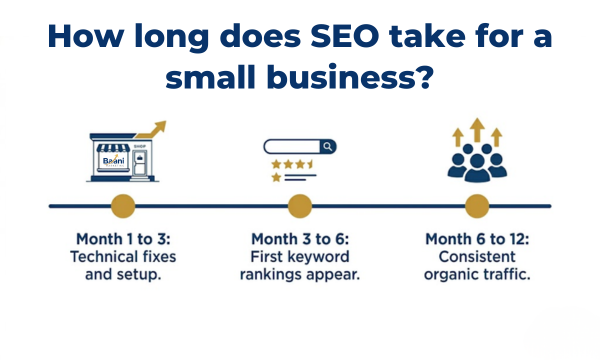
This question comes up constantly and the honest answer is: it depends on your starting point, your competition, and how consistently you work.
For low-competition keywords, you can see initial ranking movement in three to six months. Meaningful traffic typically builds between six and twelve months. Competitive head terms take twelve to twenty-four months.
Local SEO often moves faster. A well-optimized Google Business Profile with consistent reviews can show results in thirty to ninety days.
The most important thing to understand is that SEO compounds. Each piece of content, each backlink, and each technical fix builds on the last. Businesses that start now and stay consistent will have a significant advantage over competitors who wait.
Quick-Start Checklist: Your First 30 Days
Use this to get moving immediately without feeling overwhelmed.
Week 1
- Set up Google Search Console and Google Analytics
- Claim and fully complete your Google Business Profile
- Run a basic technical audit with PageSpeed Insights
Week 2
- Identify ten target keywords using Google Keyword Planner
- Optimize the meta titles and descriptions on your five most important pages
- Fix any mobile usability issues flagged in Search Console
Week 3
- Publish your first optimized blog post targeting a long-tail keyword
- Build or clean up your top five local directory listings
- Add internal links from existing pages to your new content
Week 4
- Reach out to two local websites or publications about a link opportunity
- Ask five satisfied customers to leave a Google review
- Review your Search Console data and note what is already gaining impressions
Frequently Asked Questions
1. How long does SEO take for a small business?
SEO usually takes 3 to 6 months to show noticeable results. In competitive industries, it can take longer. Local SEO results may appear faster if your Google Business Profile is optimized properly.
2. Can I do SEO myself for my small business?
Yes, you can do basic SEO like keyword research, on-page optimization, and Google Business Profile setup. However, technical SEO, backlinks, and strategy usually require experience.
3. Is SEO better than paid ads?
SEO is better for long-term growth because it brings consistent organic traffic. Paid ads give faster results but stop when you stop spending money. The best strategy is using both together.
4. Why is my website not ranking on Google?
Common reasons include weak content, no backlinks, poor technical SEO, slow website speed, and lack of internal linking or keyword targeting.
5. What is the most important part of SEO?
Content and search intent are the most important. If your content does not match what users are searching for, rankings will be difficult even with technical SEO.
6. Do I need backlinks to rank?
Yes, backlinks help build authority and trust. However, they should be natural and from relevant websites, not spam or low-quality sources.
Final Thoughts
SEO for small business is not complicated. It is consistent. The businesses that rank well are not doing anything magic. They have built a solid technical foundation, created useful content, and earned trust through real customer relationships.
Start with the basics. Fix what is broken. Create content that genuinely helps people. Build links and local authority over time.
If you want to go deeper on any part of this process, explore our full guide on digital marketing strategy for small businesses or learn how social media marketing connects with your SEO efforts.
The sooner you start, the sooner those rankings begin to compound.
Need real SEO results that actually grow your business? Our SEO services are designed to increase visibility, traffic, and conversions using proven, data-driven strategies. Get started with us today