



Most beginners open a keyword tool on day one and start chasing the biggest numbers they can find. Then they publish content for six months and wonder why nothing ranks.
The problem is almost never the content. It is the keywords.
This tutorial walks you through keyword research from scratch. No assumptions. No generic advice. Just the exact process that works for websites that are new, small, and competing without a massive backlink profile.
If you have already read our guide on how to do SEO for small business, you know keyword research is the foundation of everything. This article goes deeper into the process itself.
What Keyword Research Actually Is (and What It Is Not)
Keyword research is the process of finding words and phrases people type into Google, then deciding which ones are worth targeting with your content.
That second part matters. Finding keywords is easy. Anyone can export a list of 500 terms in ten minutes. The real skill is knowing which ones you can realistically rank for right now and which ones will actually send you customers.
Keyword research is not about tricking Google. It is about understanding what your audience is already looking for and showing up with a genuinely useful answer.
In 2026, Google’s algorithm understands context, synonyms, and topic depth far better than it did five years ago. You do not need to mention a keyword seventeen times per article. You need to cover the topic better than anything else on page one.
Step 1: Start With Your Business, Not a Tool
Before you open any keyword tool, spend fifteen minutes writing down answers to these questions.
What does your business actually do? Be specific. Not “marketing services” but “social media management for local restaurants.”
What problems do your customers have before they find you? Write those down as plain English sentences. These become your seed keywords.
What questions do people ask you in sales calls or emails? If a prospect has asked you something three times this month, there is a good chance thousands of people are Googling it.
This exercise gives you seed keywords rooted in real customer language. Tools will expand on them. But if you skip this step and let a tool generate your starting point, you will end up researching topics your customers do not actually search for.
Step 2: Understand the Three Metrics That Matter
Every keyword has three data points worth paying attention to. Learn to read all three together, not in isolation.
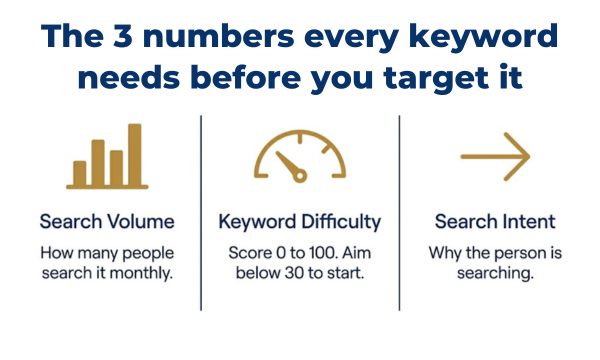
Search Volume
This is the average number of times a keyword is searched per month. Higher volume means more potential traffic. But high-volume keywords are also far more competitive. A keyword with 500 monthly searches and low competition will send you more actual visitors than a keyword with 50,000 searches that you rank for on page four.
New websites should target keywords in the 200 to 2,000 monthly search range to start. These are real, meaningful searches with far more realistic ranking potential.
Keyword Difficulty
Most tools give this a score from 0 to 100. A score under 20 is genuinely achievable for a new site. A score above 50 means you are competing with established sites that have thousands of backlinks. Be honest about where your site stands today.
Search Intent
This is the most important metric and the one most beginners ignore. Intent is the reason behind the search. Get it wrong and you can publish a perfectly optimized article and still never rank, because Google knows your page does not match what the user actually wants.
There are four intent types. Informational means the person wants to learn something. Navigational means they are looking for a specific website. Commercial means they are comparing options before buying. Transactional means they are ready to purchase right now.
Each intent type needs a different content format. A transactional keyword needs a service or product page. An informational keyword needs a guide or tutorial. Publishing a product page for an informational keyword is one of the most common and costly mistakes beginners make.
Step 3: Use Free Tools to Expand Your Keyword List
You do not need to spend money on premium tools to start. These free options are genuinely powerful for early-stage keyword research.
Google Autocomplete
Type your seed keyword into Google but do not press enter. The dropdown suggestions are real searches people are making right now. Work through the alphabet by adding a letter after your keyword to uncover a wider range of suggestions.
People Also Ask
Search your seed keyword on Google and scroll down to the “People also ask” section. Each question is a keyword opportunity. Click one question and the box expands with more related questions. This is one of the best sources of long-tail keyword ideas anywhere.
Google Keyword Planner
Free with a Google account. It shows search volume ranges and competition data. The interface is designed for Google Ads, but the keyword data is directly useful for SEO. Use it to validate search volume for terms you found through other methods.
Google Search Console
If your site is already live and verified, Search Console shows you which keywords you are already getting impressions for. This is underrated as a research tool. A keyword where you are getting impressions but ranking in position 12 to 20 is a fast optimization opportunity. A small content improvement can push you onto page one.
Ubersuggest Free Tier
Gives you keyword difficulty scores, search volume, and related keyword suggestions. Limited searches per day on the free plan, but enough for consistent research if you use it strategically.
Step 4: Separate Short-Tail from Long-Tail Keywords
Short-tail keywords are broad one or two word phrases. “Marketing tips.” “SEO tools.” “Digital marketing.” These terms have enormous search volume and enormous competition. They are dominated by websites that have been building authority for years.
Long-tail keywords are specific phrases of three or more words. “Best free SEO tools for small business.” “How to write a meta description that gets clicks.” “Keyword research tutorial for beginners.”
Long-tail keywords convert better because the intent is clearer. Someone searching “keyword research tutorial” knows exactly what they want. Someone searching “keywords” could want almost anything.
For any website less than twelve months old, long-tail keywords are where you build your foundation. Every long-tail article you rank for adds to your domain authority. That authority eventually helps you compete on broader terms.
Think of it this way. Rank for twenty specific long-tail keywords and you have a real traffic base. Chase five competitive short-tail terms and you might have nothing for two years.
Step 5: Analyze What Is Already Ranking
Before you commit to a keyword, spend five minutes studying the search results page for that term. What you see there tells you far more than any tool score.
Open an incognito browser window. Search your target keyword. Look at the top five results and ask yourself these questions.
Are these big brand websites with thousands of backlinks? If so, assess whether you can realistically create something significantly better or more specific.
What format are the top results? Listicles, long-form guides, videos, product pages? Google is showing you what it believes matches user intent for that keyword. Your content needs to match that format, not fight it.
How old are the top results? A keyword where the top results are all from 2021 and 2022 is a signal that fresher, more current content has a real chance to displace them.
How specific are the top results? If the results are all broad overviews and you can write something far more detailed and practical, that specificity becomes your advantage.
Step 6: Build Keyword Clusters, Not Individual Targets
Targeting keywords one by one is inefficient. The smarter approach is keyword clustering, which means grouping related keywords together under one primary topic.
Here is a simple example. If you are writing about email marketing, your cluster might look like this. The primary keyword is “email marketing for small business.” Supporting keywords in the same cluster include “how to grow an email list,” “best email subject lines,” and “email marketing automation tips.” Each supporting keyword becomes either a section in one comprehensive article or a separate article that links back to the primary one.
This approach builds topical authority. When Google sees that your site covers a topic thoroughly from multiple angles, it treats you as a credible source on that subject. One comprehensive cluster of content outperforms ten disconnected articles targeting random keywords.
A cluster also protects you from keyword cannibalization. That is when two of your own pages compete against each other for the same keyword. It splits your ranking signals and often means neither page ranks well. Clear clusters with distinct primary keywords for each page prevent this entirely.
Step 7: Map Keywords to Pages Before You Write Anything
Before publishing a single article, build a simple keyword map. This is just a spreadsheet with four columns: the primary keyword, the page or article it will target, the search intent, and the priority level.
Every keyword gets assigned to exactly one page. No duplicates. No overlap.
This map becomes your editorial calendar. You can see at a glance which topics you have covered, which ones are missing, and which ones to prioritize based on difficulty and search volume.
Priority should go to keywords that meet all three of these criteria: search volume above 200, keyword difficulty below 30, and clear commercial or informational intent that matches a page you can actually create.
If a keyword fails on any one of those three criteria, move it to a secondary priority list and revisit it in three to six months as your site grows.
Step 8: The One Mistake That Kills Most Keyword Strategies
There is one mistake that shows up constantly in beginner keyword research. It costs months of wasted effort and it is completely avoidable.
Targeting a keyword based on volume without checking the actual search results page.
A bakery in a small US city once spent three months writing beautiful blog posts about sourdough bread. Detailed recipes, stunning photos, genuinely helpful content. After ninety days they had fourteen organic visitors total. The content was not the problem. The keywords were. Every term they targeted was dominated by major food publications with domain authority scores above 70. No amount of good writing was going to beat those sites in the short term.
The fix is simple. Always check the SERP before committing to a keyword. If the first page is controlled by major brands you cannot compete with, find a more specific angle. “Sourdough bread recipe for beginners” might be hard. “Sourdough bread starter tips for dry climates” might be very achievable. Specificity is not a limitation. It is a strategy.
How to Know If a Keyword Is Worth Targeting Right Now
Run every keyword candidate through this quick four-point check before adding it to your content plan.
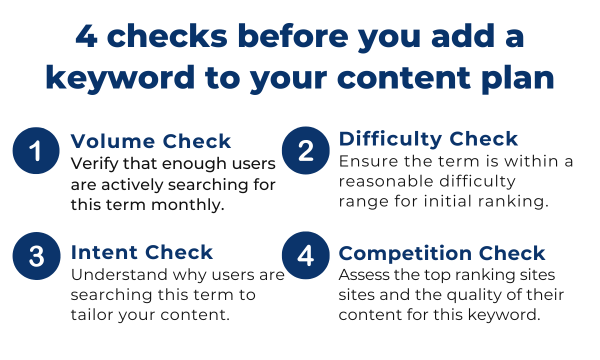
Volume check. Is there at least 100 to 200 monthly searches? Below that and even a top three ranking sends almost no traffic.
Difficulty check. Is the keyword difficulty score below 30 for your domain? Be realistic. A brand new site should not target keywords above 20 for the first six months.
Intent check. Does the search intent match the page you can create? Check the SERP to confirm.
Competition check. Are any of the top five results from small or medium websites rather than major brands? If so, you have a realistic path to page one.
A keyword that passes all four checks goes into your active content plan immediately. One that fails even one check goes into a future list or gets refined into something more specific.
A Real Example of This Process End to End
Say you run a small digital marketing agency. You are writing your first ten blog posts. You start with the seed keyword “social media marketing.”
That term has 200,000 monthly searches and a keyword difficulty of 78. Not a starting point for a new site.
You run it through Google Autocomplete and find “social media marketing tips for small restaurants.” You check the SERP. The top results are from general marketing blogs, not restaurant-specific sources. Keyword difficulty is 18. Monthly searches are around 480.
That is your keyword. Specific enough to rank. Relevant enough to attract the right audience. Achievable enough for a new site.
You write one in-depth article targeting that keyword. You link to it from your main social media services page. You add it to a cluster with related articles you will write over the next two months.
That is keyword research done right. Not a spreadsheet of 300 terms. One good keyword, properly validated, mapped to a page you can win.
Tools Worth Paying For When You Are Ready
Free tools are enough to start. When your site has some traction and you are ready to invest, these three paid tools are the most useful for small businesses.
Ahrefs gives you the most accurate keyword difficulty scores and the best backlink data. It also shows you which keywords your competitors rank for, which is one of the fastest ways to find your next content opportunities.
Semrush has a strong keyword gap tool. Enter your domain and a competitor’s domain and it shows you every keyword they rank for that you do not. This alone is worth the monthly cost once you are publishing consistently.
Ubersuggest paid tier removes the daily search limit and adds competitor tracking. It is the most affordable entry point if budget is tight.
None of these tools replace good judgment. They show you data. You still have to decide what to do with it.
Building Your First Keyword List: A Simple Starting Point
If you are reading this tutorial to actually start, here is the simplest possible action plan.
Open a blank spreadsheet right now. Add five columns: Keyword, Monthly Searches, Difficulty Score, Intent, and Priority.
Spend one hour with Google Autocomplete, People Also Ask, and Google Keyword Planner. Find twenty keywords related to your business. Fill in the data for each one.
Filter to keep only the keywords with difficulty below 30. Cross-reference each one with a manual SERP check.
Whatever remains on your list is your starting content plan. Build your first three articles around the top three keywords. Link them to each other and to your main service pages.
Then do this exercise again in thirty days. Your keyword map grows with your site.
For the next step after keyword research, read our guide on on-page SEO for every page you publish. It covers exactly how to use your chosen keywords inside your content without over-optimizing.
Frequently Asked Questions
1. What is keyword research in simple terms?
Keyword research is the process of discovering what people search on Google and selecting the best terms to target with your content. It helps you understand real user demand instead of guessing what to write.
2. How long does keyword research take?
For a single blog post, keyword research usually takes 20–30 minutes. For a full website plan, it can take 2–3 hours. It should be reviewed again every few months as search trends change.
3. Do I need paid tools for keyword research?
No, you can start with free tools like Google Autocomplete, People Also Ask, Google Keyword Planner, and Google Search Console. Paid tools become useful when you need deeper competitor insights and scaling.
4. What is the difference between short-tail and long-tail keywords?
Short-tail keywords are short and broad, like “SEO tips.” Long-tail keywords are more specific, like “SEO tips for small business websites.” Long-tail keywords are easier to rank and bring more targeted traffic.
5. What is keyword difficulty?
Keyword difficulty is a score that shows how hard it is to rank for a keyword. New websites should focus on keywords with lower difficulty (usually under 30) to improve their chances of ranking faster.
6. What is search intent in SEO?
Search intent is the purpose behind a search query. It can be informational, commercial, navigational, or transactional. Matching your content to search intent is essential for ranking on Google.
7. What is keyword cannibalization?
Keyword cannibalization happens when multiple pages on your website target the same keyword. This causes them to compete with each other and can reduce overall rankings.
8. How often should keyword research be updated?
Keyword research should be reviewed every 3–6 months. This ensures your content stays aligned with changing search trends and user behavior.
9. Can I do keyword research without tools?
Yes. Google Autocomplete and People Also Ask are enough to start. However, tools help you understand search volume and competition more accurately.
10. How many keywords should I target per article?
Each article should focus on one main keyword. You can include a few related keywords naturally, but the content should stay focused on a single primary topic.