


Most small businesses do one of two things. They run ads and hope for sales. Or they publish content and hope for leads.
Neither works consistently. Not because the tactics are wrong. Because there is no structure connecting them.
That structure is the marketing funnel. And once you understand it, you will stop wondering why your traffic is not converting.
This is not a theoretical breakdown. This is how the funnel actually works for small businesses in 2026, where customers bounce between Google, your website, reviews, and social media before they ever make a decision.
What Is a Marketing Funnel?
A marketing funnel is a framework that maps how a stranger becomes a customer. It shows the stages a person moves through from the moment they first hear about you to the moment they buy, and ideally, the moment they buy again.
The word funnel exists because the numbers narrow at every stage. You might reach ten thousand people at the top. A thousand of them visit your website. A hundred sign up for something. Ten become customers. That narrowing is normal. Your job is to make each stage as efficient as possible so more people make it to the next one.
What the textbook version gets wrong is that funnels in real life are not straight lines. A person might read your blog post today, forget about you for three weeks, see you mentioned in a Reddit thread, visit your website again, compare you to two competitors, read your reviews, and then email you. That entire journey might take forty days.
The funnel does not capture every twist. But it gives you a structure to think about where a person is in their decision process and what they need from you at that moment.
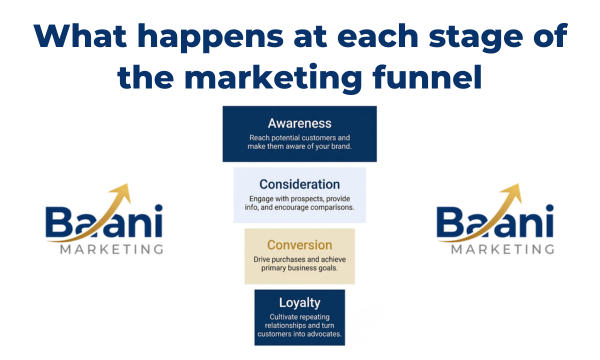
The Four Stages of a Marketing Funnel
Every funnel has the same core structure regardless of what you sell. The names vary depending on who is explaining it. The logic does not.
Stage 1: Awareness (Top of Funnel)
This is where someone first encounters your business. They are not looking for you specifically. They are looking for an answer to a problem or a question they have.
They might find you through a Google search. A social media post. A referral from a friend. A blog article. An ad that interrupted their scrolling.
At this stage they do not know who you are and they do not care yet. Their only question is whether you have something relevant to offer.
The most important thing to understand about the awareness stage is that people here are not ready to buy. They are gathering information. If you hit them with a hard sales pitch at this point, they leave and never come back.
What works at the awareness stage: SEO blog content, social media posts, short videos, podcast appearances, and Google ads targeting informational keywords. The goal is not conversion. The goal is trust. Show up with something genuinely useful and they will remember you when they are ready to go deeper.
Understanding how to do SEO for small business is what puts you in front of these people at the exact moment they are searching.
Stage 2: Consideration (Middle of Funnel)
The person now knows their problem clearly. They are actively comparing solutions. They might be looking at you alongside two or three competitors.
At this stage they are asking more specific questions. How does your service work? What results have other people seen? What makes you different from the other options they are considering?
This is where most small businesses go quiet. They have awareness content. They have a contact page. But there is almost nothing in between to help someone move from curious to confident.
What works at the consideration stage: case studies, detailed service pages, comparison content, email sequences, free guides or resources, webinars, and testimonials with specific results. The goal is to reduce uncertainty and build enough trust that they feel comfortable taking the next step.
This stage is where email marketing becomes powerful. Someone who downloads a free guide from your site is in the consideration stage. A well-structured email sequence that answers their remaining questions over the next two weeks is the thing that moves them forward. We cover this fully in our guide on email marketing best practices.
Stage 3: Conversion (Bottom of Funnel)
The person is ready to act. They have done their research. They have a shortlist. Now they just need a reason to choose you and a clear path to do it.
At this stage friction is your enemy. Every unnecessary step, every confusing page, every hidden price, every slow-loading form is a reason for them to abandon. One study found that sending paid traffic to a homepage instead of a dedicated landing page is one of the most expensive mistakes a business can make. The homepage does nothing. It is not built to close.
What works at the conversion stage: clear landing pages with one focused call to action, transparent pricing, a simple and fast contact or purchase process, strong guarantees or risk reversals, and urgency when it is genuine.
One thing that often gets overlooked here: response time. If someone fills out a contact form on your website and you reply twenty-four hours later, you have likely already lost them. Studies consistently show that leads contacted within five minutes of inquiry are dramatically more likely to convert than those contacted an hour later.
Stage 4: Loyalty (Post-Purchase)
Most marketing funnel diagrams stop at conversion. That is a significant mistake.
Acquiring a new customer costs five to seven times more than retaining an existing one. The customers you already have are your easiest source of repeat revenue and referrals.
The loyalty stage is about delivering on the promise that got them through the funnel and then continuing to add value after the sale. A happy customer who hears from you regularly with useful content, who feels looked after, will buy again, refer others, and leave reviews that bring more people into the top of your funnel.
What works at the loyalty stage: post-purchase email sequences, loyalty offers for returning customers, asking for reviews at the right moment, and staying in touch with genuinely useful content rather than just promotional messages.
TOFU, MOFU, BOFU: What These Terms Actually Mean
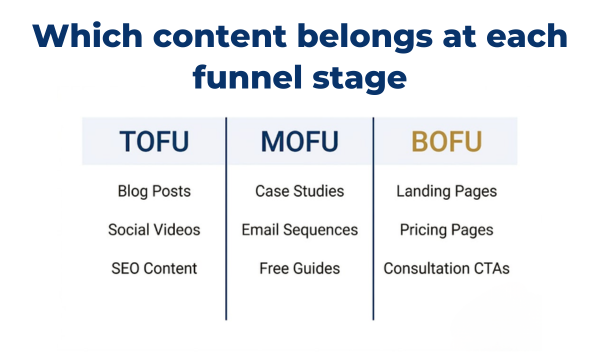
You will see these three abbreviations everywhere in marketing. They are simply shorthand for the funnel stages.
TOFU means Top of Funnel. This is the awareness stage. Content here reaches the widest audience.
MOFU means Middle of Funnel. This is the consideration stage. Content here speaks to people who already know their problem.
BOFU means Bottom of Funnel. This is the conversion stage. Content here speaks directly to people who are close to making a decision.
The reason these labels matter is that the wrong content at the wrong stage actively hurts your results. Publishing a blog post that reads like a sales pitch drives away TOFU visitors who were not ready to buy. Publishing a generic educational piece on a landing page designed to convert BOFU visitors confuses people who wanted a clear next step.
Every piece of content you create should have a clear funnel stage assigned to it. Then it can be written, formatted, and distributed in a way that actually matches what the reader needs at that moment.
Marketing Funnel vs Sales Funnel: What Is the Difference?
These terms get used interchangeably and that causes confusion.
A marketing funnel covers the entire journey from stranger to customer. It is owned by the marketing function of a business. It includes all the touchpoints that create awareness, build consideration, and drive conversion.
A sales funnel is a subset. It typically picks up once a lead has been identified and tracks their progress through a sales process toward a closed deal. It is more relevant to businesses with a dedicated sales team or a longer B2B sales cycle.
For most small businesses, the distinction does not matter much in practice. You are running both simultaneously and the same person is often responsible for both. What matters is that you have a clear path from first contact to closed customer, with specific actions and content at each stage.
Where Most Small Businesses Lose Customers
After working with businesses across different industries, the same funnel problems show up repeatedly. They are not exotic. They are quiet and consistent.
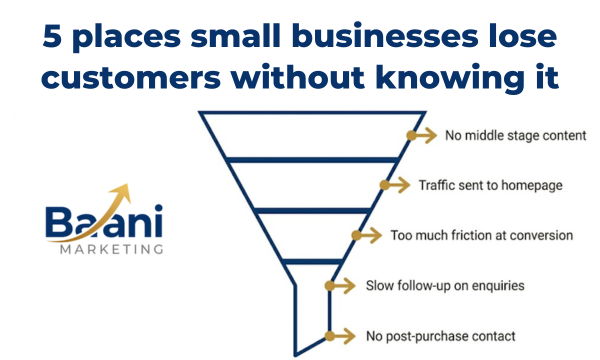
They skip the middle. There is awareness content and there is a contact page. There is nothing in between to nurture someone from interested to ready. The customer reaches a dead end and leaves.
They send all traffic to the homepage. The homepage is designed for everyone, which means it speaks clearly to no one. A person arriving from a specific Google search or a specific ad needs a page that speaks directly to what they were looking for.
They only optimize for the last click. A customer might read three blog posts, watch a video, and see two ads before converting. If you only track the last thing they did before buying, you will cut the earlier touchpoints that actually started the journey. In 2026 the customer journey often involves seven to thirteen touchpoints before a decision is made.
They ignore existing customers. The funnel ends at purchase and the customer hears nothing until they happen to need something again. A simple email sequence after a purchase, a check-in thirty days later, a useful tip relevant to what they bought – these small touches compound into long-term loyalty.
They create content without knowing which stage it serves. A team publishes a mix of blog posts, social media content, and emails with no strategic connection between them. Traffic comes in but nothing moves anyone forward because the content was never designed to work as a system.
How to Build a Simple Marketing Funnel from Scratch
You do not need sophisticated software or a large team to build a functional funnel. Here is the simplest version that actually works for a small business.
Start with one clear customer problem. Not your whole business. One specific problem one specific customer has. Build your funnel around solving that problem.
Create one piece of TOFU content. A blog post, a social media video, or a short guide that addresses the problem at the awareness level. Optimize it for search so people find it without you having to pay for every visitor. Your keyword research process determines whether this content gets found or disappears.
Create one lead magnet for MOFU. A free checklist, a template, a short guide, or a mini email course that someone can access in exchange for their email address. This captures the people who are interested enough to go further.
Build a three to five email nurture sequence. Once someone downloads your lead magnet, send them a short series of emails over the following ten to fourteen days. Each email addresses a common question or objection they have at the consideration stage. End the sequence with a clear, low-friction invitation to take the next step with you.
Create one focused conversion page. A landing page or service page built around one specific action. Book a call. Request a quote. Start a trial. One page, one goal, no distractions.
Set up a simple post-purchase follow-up. Even two emails – one right after purchase and one thirty days later – is better than silence. Ask how things are going. Share something useful. Ask for a review.
That is a complete funnel. It is not complicated. The businesses that outperform their competitors are usually not doing something dramatically different. They are doing the basics consistently with a clear structure connecting each step.
What Content Works at Each Funnel Stage
This is where many content plans fall apart. They produce content without connecting it to a funnel stage. Here is a quick reference.
Awareness stage content: Blog posts targeting informational keywords, short social media videos, podcast interviews, infographics, Google and social ads targeting broad audiences.
Consideration stage content: Detailed guides, case studies, comparison pages, email nurture sequences, webinars, free templates or tools, testimonials with specific results, FAQ pages.
Conversion stage content: Service or product pages, landing pages with a single call to action, pricing pages, consultation booking pages, limited-time offers, guarantees and risk reversals.
Loyalty stage content: Post-purchase email sequences, exclusive content for existing customers, referral programs, review requests sent at the right moment, useful newsletters.
For a full breakdown of how to plan and produce content that moves people through each stage, read our guide on content marketing strategy for beginners.
How to Measure Whether Your Funnel Is Working
A funnel you cannot measure is a funnel you cannot improve. You do not need complex analytics to start. You need a few clear numbers at each stage.
At the awareness stage, track organic traffic, social reach, and impressions. Are people finding you?
At the consideration stage, track email signups, lead magnet downloads, and pages per session. Are people engaging deeply enough to show real interest?
At the conversion stage, track conversion rate on your key landing pages and the number of enquiries or purchases. Are interested people actually taking action?
At the loyalty stage, track repeat purchase rate, referral numbers, and review volume. Are customers coming back and bringing others?
When a number drops, you know exactly where the funnel is leaking and you can fix that specific stage without guessing. We cover the full measurement process in our guide on how to measure digital marketing success.
Frequently Asked Questions
What is a marketing funnel in simple terms?
A marketing funnel is a framework that maps the journey a person takes from first discovering your business to becoming a customer. It helps you understand what information, content, or support people need at each stage of the buying process. The funnel starts wide because many people enter at the awareness stage and narrows as only a percentage move toward a purchase.
How many stages does a marketing funnel have?
Most marketing funnels use four stages: awareness, consideration, conversion, and loyalty. Some businesses simplify this into three stages, while others create more detailed versions. The exact number is less important than understanding what your audience needs before moving to the next stage.
What is the difference between TOFU, MOFU, and BOFU?
TOFU, MOFU, and BOFU stand for Top of Funnel, Middle of Funnel, and Bottom of Funnel. These terms describe where someone is in the buying journey. Top-of-funnel content builds awareness, middle-of-funnel content helps people compare options, and bottom-of-funnel content encourages action and conversion.
What is the difference between a marketing funnel and a sales funnel?
A marketing funnel focuses on attracting, educating, and nurturing potential customers before they buy. A sales funnel focuses on converting qualified leads into paying customers. For many small businesses, marketing and sales activities overlap, so the distinction is often less important than ensuring the entire customer journey works smoothly.
Why is my funnel not converting?
Poor conversion rates are usually caused by missing steps in the customer journey. Common issues include sending visitors directly to a sales page without building trust, unclear calls to action, weak landing pages, slow follow-up, or too much friction during the conversion process. Identifying where people drop off is the first step toward fixing the problem.
Do I need expensive software to build a marketing funnel?
No. Most small businesses can build an effective funnel using a website, a landing page, and a basic email marketing platform. Expensive software is rarely the reason a funnel succeeds. Strategy, messaging, and consistency matter far more than tools.
How long does it take for a marketing funnel to work?
Results depend on your traffic levels and how long customers typically take to make a decision. Businesses with existing traffic may see improvements within 30 to 60 days, while a new funnel built around organic traffic often takes 3 to 6 months to generate meaningful results. Long-term gains usually come from improving retention and customer loyalty.
What is a funnel leak?
A funnel leak occurs when potential customers leave the buying journey before reaching the next stage. Examples include visitors abandoning a landing page, subscribers ignoring follow-up emails, or leads failing to receive a response after making an enquiry. Fixing leaks often produces faster results than simply increasing traffic.
Should I build different funnels for different services?
Yes. Different services often attract different audiences with different needs and decision-making processes. Creating separate funnels allows you to deliver more relevant content, messaging, and offers, which generally leads to higher conversion rates.
How does SEO connect to the marketing funnel?
SEO helps people discover your business through search engines, making it one of the strongest top-of-funnel marketing channels. When someone finds your content through Google, they enter your funnel at the awareness stage. Strong SEO creates a steady stream of qualified visitors without relying entirely on paid advertising.
What is the biggest mistake small businesses make with marketing funnels?
The biggest mistake is trying to sell too early. Most people need education, trust, and proof before they are ready to buy. Businesses that focus only on conversion often lose potential customers who are still in the awareness or consideration stages. A successful funnel guides people through the entire journey rather than rushing them to a purchase.